 Landscapes Magazine is an award-winning publication of the Texas Farm Credit District lending associations.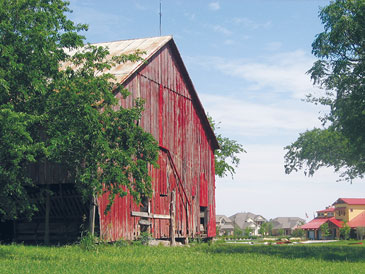
Landowners who sell once-agricultural property in urban areas, like that pictured, and reinvest in like-kind property, often can save taxes with a 1031 exchange.
Photo by Janet Hunter
Whenever Kerrville, Texas, rancher David Gregory buys or sells land, he makes certain his investment real estate contract contains one important paragraph: wording that enables him to place proceeds into a 1031 tax-deferred exchange.
The Capital Farm Credit customer and owner of Rod and Gun Resources Inc. is not alone. Rural property sellers in high-appreciation areas, and those who’ve built significant equity, are avoiding long-term capital gains taxes through the IRS Section 1031 exchanges. But, it takes the right planning.
"Just about every one of the contracts we see nowadays is written with a 1031 clause," says Ronny Johnson, chief appraisal officer with Capital Farm Credit in New Braunfels, a hotbed of recreational property and housing development between San Antonio and Austin.
"With escalating prices, people have a lot of equity. We’ve seen quite a few old ranching families that are in transition areas surrounding metropolitan areas," he says. "They are still trying to farm and ranch, and as values escalate, they are moving out farther west."
With a 1031 exchange, those families can sell their valuable property for a significant profit and reinvest those proceeds in a like-kind property, with no tax hit. "In these areas farther removed from metro areas, the price per acre is less and they can buy more acreage," he says.
What Are 1031s?
Austin attorney and 1031-qualified intermediary (QI) Craig Dunagan of Travis County Exchange Corporation has facilitated more than 1,500 of the increasingly popular 1031 exchanges since the mid-1980s. That’s when the new Tax Reform Act introduced "safe harbor" rules necessitating the use of a third-party accommodator to escrow and distribute the funds in deferred exchanges.
The IRS code allows sellers to apply net proceeds from investment property sales to purchase "like-kind" investment property of equal or greater value. Note, however, that the rules require (a) the seller to reinvest cash received from the sale, and (b) if a mortgage was paid off, the seller must either add cash equal to that mortgage amount or replace the mortgage with one of the same or a higher amount.
Qualifying property includes farmland and ranchland, rental property and other real property used for business or investment purposes.
Two types of situations that don’t work for 1031 exchanges, Dunagan says, are:
- Personal Use Property – including personal homes and vacation homes used more than two weeks a year
- Dealers – those in the business of buying and reselling properties quickly or buying property in bulk and then carving it up into multiple lots for resale
Types of Exchanges
According to Bill Hopewell, senior appraiser with the Federal Land Bank Association of North Alabama in Albertville, there are three types of 1031 exchanges:
- Deferred or Delayed Exchanges. With these exchanges, a property-owner sells the property, with the proceeds going directly to a qualified intermediary at the sale’s closing. The seller has 45 days to identify in writing typically up to three potential like-kind replacement properties, and within 180 days must close the purchase transaction on the replacement property. Other rules allow more than three replacement property picks.
- Simultaneous Exchanges, in which the seller relinquishes title to the old property and takes possession of the new property in the same transaction.
- Reverse Exchanges, whereby the replacement property is purchased first and "parked" with an exchange accommodation titleholder, and the relinquished property is sold within 180 days. The replacement property is reconveyed by the exchange accommodation titleholder to complete the exchange.
The most common type is a deferred exchange. However, this type can be fraught with challenges. "You’re only allowed 45 days to nominate the three properties, so you need to know where you anticipate buying and try to identify your replacement property in advance," says Larry D. Kokel, a real estate appraiser and broker with Kokel-Oberrender-Wood Appraisal, Ltd., in Georgetown, Texas.
That looming deadline can sometimes cause buyers to make rash decisions. "As a lender, we sometimes see an individual highly motivated to find something within the 45 days, and they sometimes end up paying a premium," notes Capital Farm Credit’s Johnson.
Making It Happen
Gregory agrees. Even though he has included the 1031 clause in many contracts, it wasn’t until recently that he was able to use it. "We were selling a ranch near Junction, and had already identified a ranch near Kerrville to buy," he says. "On this one, everything just fit into place."
The first QI his attorney recommended wanted a $2,500 fee to facilitate the transaction, but Gregory opted for a California firm that his title company recommended, paying them about $800. "It’s a little bit of a gamble because your cash profit goes directly to them at the sales closing, and you need to be sure you can trust them," he says.
What Is "Like-Kind" Property?
Kokel says the definition of like-kind property is fairly broad, as long as the properties are held for investment. "Around the perimeter of Austin, prices are to the point where a Blackland farm is worth more for houses than for cotton or corn," he says. "I’ve seen a farm sold and a 1031 done on an apartment complex. I’ve sold some property along IH-35 that had appreciated substantially, and bought three other farms in outlying areas that hadn’t had as much appreciation. Both scenarios qualify."
Although the Land Bank’s Hopewell says 1031s aren’t as common in his area, he used one when selling some Clay County timberland whose value had quadrupled. "We held it for investment and knew we would have significant long-term capital gains, so we used a 1031 exchange to buy a condominium in Auburn that we rent out to a student," he said.
On farm and ranch investment properties that include a homestead, Dunagan says federal and state laws allow the seller who has owned and lived in a farm or ranch residence in two out of the last five years to identify the house, an access easement and one acre as homestead. "The beauty of that is you can take up to a half-million-dollar gain if married and a quarter-million if single tax-free out of the residential sale proceeds, and don’t have to reinvest it," he says. "The rest becomes the sale of the working ranch or productive farm."
Get Good Advice
"If you intend to buy and sell investment property, it just makes sense to put the 1031 clause in your documents," says Gregory. "Every good ranch Realtor knows about these, and the phrasing that must be included in your contract."
Before embarking on a 1031 exchange, the experts advise that you visit with your accountant to understand your basic costs and potential taxes, and then work with an experienced and reputable QI and attorney.
"Don’t just get caught up in the frenzy of doing it to save the 15 percent tax," advises Kokel. "Make sure you are meeting your wants and needs, and that your decision makes market sense."
– Article by Sue Durio