 Landscapes Magazine is an award-winning publication of the Texas Farm Credit District lending associations.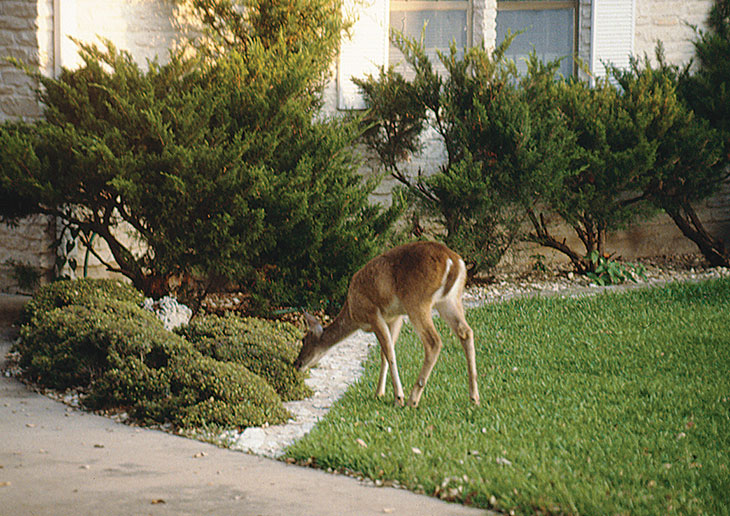
As elusive and timid as deer may seem, don't let them fool you. When it comes to home gardens and landscapes, deer can be destructive as they forage their way through your prized plants. Even if you can't set your property off limits, you can always try the following methods to deter these pesky and persistent creatures.
Shrubs and Plants
Although deer are picky eaters, hungry ones will eat any forage available; therefore, there are few completely deerproof plants. However, there are ways to use shrubs and plants to decrease deer foraging, such as:
Placing plants that deer prefer least along the edges where the most problems occur.
Planting borders of a species that deer prefer, such as crimson clover, so your preferred plants can be saved.
Fencing and Caging
Perhaps the most expensive option, fencing is also the most effective method, especially for long-term purposes. Popular choices include electric fencing, slant fencing and woven wire fencing. New shrubs and trees having less than 3 feet of clear trunk should be protected with cages at least 4 feet high. Young trees are especially vulnerable to antler rubbing, because bucks prefer to rub trunks no more than one or two inches thick.
Commercial Repellents
Commercial repellents work by causing a bad taste or odor. However, these have limited effectiveness, as weather, deer population and availability of food choices must be considered. Most repellents work for a brief time and must be reapplied often, and are most economical when applied to a small, easily accessible area. Products containing the following ingredients are commonly used options:
Egg solids are by far the most preferred ingredient used in deer repellents. It is considered a minimal-risk ingredient by the EPA.
Bone-tar oil adheres to plants longer than most other ingredients.
Pepper sauce can be applied as a taste repellent, and when mixed with water is sprayed directly onto plants.
Thiram is recommended for hardy plants, as it is typically sold as a fungicide.
Predator urines give deer the idea that a predator is present. They should not be sprayed on plants but are poured in the general area; they are useful for protecting the most delicate flowers.
Home Remedies
More cost-effective repellents can be made with everyday items. However, deer adapt quickly, so rotating the techniques every few weeks is recommended.
Small net bags filled with human hair can be hung in the area, but this method has limited success, as the deer population must be low and the weather must be adequate -- human hair loses odor over time and does not smell at all when temperatures are low.
Ammonium-based soaps can emit an unfavorable odor, and can be used in the same way as human hair.
Noisemakers, such as radios or propane cannons, can be used to frighten deer away, but will only work for a short time because deer adjust quickly to noise patterns.
-Staff