 Landscapes Magazine is an award-winning publication of the Texas Farm Credit District lending associations.
 When Hurricane Katrina slammed into Louisiana, Mississippi and Alabama on Aug. 29, 2005, millions of trees were downed or topped off, like match sticks in a hail storm.
The USDA Forest Service estimated that 19 billion boardfeet of timber was damaged on more than 5 million acres in the three states. Eighty percent of the damage occurred in 10 of Mississippi's southernmost counties, leaving forest landowners to salvage trees for chipping.
Timber grower and mill owner Cortez Byrd from Brookhaven, in south-central Mississippi, found himself helping other growers pick up the pieces -- literally.
"Even though a lot of the timber that was salvaged came from land farther south, the chip mills in that area couldn't keep up with the volume," says Byrd. "A lot of the salvaged timber came to our mill, and that really helped our business. It took about nine months to process all of that."
Fortunately for Byrd, changes he had made in technology prior to Katrina allowed him to meet the demand.
Eight years ago, his business encompassed 8,500 acres of Mississippi forestland, two saw mills and two chip mills in Brookhaven, and a chip mill in Magnolia, Miss. His 120 employees were generating $20 million in revenue each year for the local economy.
Since then, Byrd has turned to Land Bank South to expand his business time and again -- diversification that is helping him weather a housing market slowdown, a Japanese recession and exorbitant fuel costs.
Last year he purchased Franklin Timber Company in Bude, Miss. -- a facility that cuts mostly smaller-dimension lumber such as 2x4s and 2x8s used in construction, and is large enough to keep five drying kilns busy.
"Right now the dimension lumber market is down because of the slow housing market and an oversupply of available product," says Byrd, who is looking to 2009 for a rebound. In the meantime, he and other mills have had to cut employees' hours and lay off some staff. He currently employs 200.
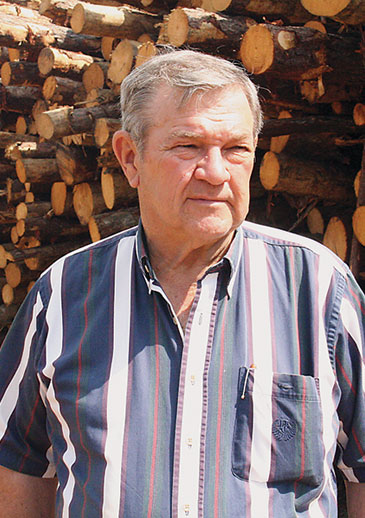
Cortez Byrd
Photo by Johnathon Alford
Chip Mills Pay the Bills
"If it weren't for the chip mill and the large-timber mill, our overall business would really be hurting," Byrd says. Last year, his chip mills produced 670,000 tons of chips -- up from 500,000 tons in 2000.
He also has expanded his timber holdings by about 10,000 acres, which has enabled him to offer customized services.
"He can take an individual order for a certain size timber, and go out and select individual trees to meet a customer's specifications," says Gary Blair, senior vice president of Land Bank South in Brookhaven.
Oil Industry Fuels Timber Demand
Strong domestic oil production is driving demand for lumber from Byrd's large-timber mill. That facility produces large lumber -- from 6x6s up to 24x24s -- used in construction of bridges, docks, roads and oil fields. "Even though highway construction is down, there's a lot happening in domestic oil fields, and that has been good for our large-lumber business," says Byrd.
New technologies are helping his company reap efficiencies as well. He has added computerized stackers that sort and stack lumber in the saw mill, and lasers to guide more efficient cutting. "The advances in technology are helping us minimize waste and reduce labor expense," says Byrd.
Those are welcome savings to help offset spiking fuel and steel costs. The $30,000 cost per fuel-transport-load to keep his truck fleet on the roads is up threefold since 2000. And steel chain used in the chip mill has jumped from $18 per foot to $40 per foot today.
But Byrd's management skills and industry knowledge will continue to serve him well in these uncertain markets, according to Blair.
"He is a very good manager and has a good understanding of timber markets and the forest industry," Blair says. "We are proud to have him as a stockholder."