 Landscapes Magazine is an award-winning publication of the Texas Farm Credit District lending associations.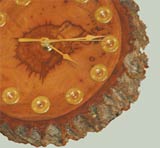
From an old tree stump and empty shotgun shells, Ken Plunk crafted a rustic clock to hang in the office of his log home in rural Marshall County, Miss. "But I never put a battery in it," says Plunk, retired CEO of the former Union Planters Bank in Memphis, Tenn. "Out here I don't need to know what time it is." Plunk used to commute into Memphis from nearby Germantown, Tenn., where he and Patricia, his wife of 47 years, still live. Now, every chance he gets, he commutes in the opposite direction to their property about 50 miles south.
A 17-Month Building Process
Their "home away from home" is a beautiful, 3,100-square-foot log cabin that they built after he retired in March 2004. A hobby woodworker, Plunk appreciates wood and craftsmanship, and it shows in every detail of the two-story house. "Every board, every fixture, everything has a story," Plunk says.
Take the name of the property, Four Oaks, for example. When they settled on the location to build the barn, lake and house, Plunk noticed that four prominent oak trees dominated the landscape: a white oak by the lake, a white oak and post oak by the driveway, and an interesting red oak with a split trunk near the house.
"I decided to call it Four Oaks," Plunk says. "But one night a storm came through, and one side of the split trunk fell off. When I saw it the next morning, I called Patricia and told her we might have to change the name to Three and a Half Oaks," he jokes.
That characteristic sense of humor helped Plunk endure the 17-month building process. At one point, a two-month wait for Douglas fir beams led Plunk to contact a friend and ask to use old billboards from his company as temporary roofing.
One of them showcased a woman in a skimpy dress advertising a casino. "They asked me whether I wanted it facing in or out," Plunk says. He thought about the neighbors for a second before answering, with a laugh, "You'd better face her in."
Finished Product Fulfills Dream
Although a few adjustments were made to the original plans, the finished product is the home they envisioned.
"The plan evolved a little, but the only major change was that we used siding outside instead of logs," Plunk says.
Prior to construction, the Plunks read extensively about log cabin design. They realized that log homes are not energy efficient, so they opted for a six-inch stud-wall construction with insulated walls. But they intended to use split logs on the outside to give the appearance of a log home.
Ken Plunk, pictured here in the upstairs living area with his antique tool collection, spends almost every weekend at the house in the country.
They harvested pine from the property and set up a sawmill nearby. No matter how straight the logs were cut, however, they were always bowed or had other flaws. Plunk quickly abandoned that plan and instead ordered yellow pine siding from Hohenwald, Tenn.
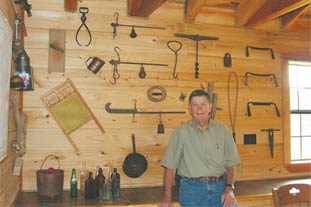
Ken Plunk, pictured here in the upstairs living area with his antique tool collection, spends almost every weekend at the house in the country.
Variety of Mississippi Lumber
A variety of lumber graces the inside of the home, and Plunk knows where each wood came from and why it was used. Cedar harvested from a place north of the farm was used to line the closets and make posts for the wraparound porch. The interior doors are made of cypress from Water Valley, Miss., and the flooring is pine from Oxford, Miss.
The flooring is constructed from 1- by 12-inch pine boards that most builders use for closet shelving. It has the appearance of peg construction, but the pegs are actually cedar plugs that Plunk made on his drill press. The plugs cover the screws which hold the floor securely in place.
The hickory kitchen cabinets were ordered, not constructed. "I wanted a rustic kitchen, but Patricia said 'no,'" Plunk recalls. "She said if she was going to be cooking meals for the family, she wanted a modern kitchen. I agreed, and I think it turned out really nice."
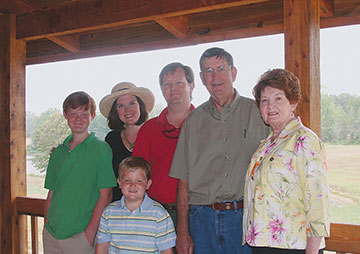
Pictured from left to right: Austin, Lori, Carson and Ned French, and Ken and Patricia Plunk
100-Year-Old Wood
A large bookcase in the great room, a recessed bar in the dining area and the bathroom vanities contain the prized wood that was rescued from four old homes that remain standing on the property. They were built by Plunk, James Gregory, a master carpenter on the job, and Ward Clifton, a cabinet maker in Potts Camp. Clifton's son, Brad, did the plumbing in the cabin.
The 100-year-old wood, dark from age, includes pine, walnut, poplar and red oak. Two floor beams from the old homes became posts in the living room. It was that connection to the past that interested head builder, Tony Wiley, from Water Valley, Miss., who loves to restore old structures or build new ones from old materials. He oversaw a crew that made the 50-mile trek almost every day to complete the project. He now builds $500,000 homes in Oxford, Miss.
A Perfect Country Escape
Four Oaks is a perfect retreat for the couple and their family, especially their daughter Lori French, her husband, Ned, and their two sons, Austin and Carson, who live in Little Rock, Ark., and come to visit often.
From his woodworking shop in the barn, Plunk made each grandson a pirogue, a Cajun-style canoe, that they use on the property's lakes and river. The lake nearest the house was built while the house was under construction.
Plunk bought the first parcel of land more than 20 years ago, and recently purchased an adjoining 338 acres, bringing the total to 1,024 acres. He worked with the Land Bank of North Mississippi to finance the latest land purchase.
"Ken's farm is about as diverse as they come in North Mississippi," says Joe Hill, branch office president of the Land Bank's Senatobia office. "He has bottomland row crops that he rents to a local farmer, and pastureland, where the farmer grazes longhorn cattle. He also has a large stand of hardwood timber and a loblolly pine plantation. With all this diversity comes an abundance of wildlife, too."
These days, Plunk spends about half his time down on the farm. He serves on the board of a bank holding company, but he schedules meetings early in the week so that he can escape to the country before the weekend.
A true retreat, the farm does not have a computer or a telephone, and an entire day can go by while he is working in his shop or hunting. He does have a cell phone, but he admits, "Sometimes I turn that off too."
- Staff